


Transparency and risk guide marine insurability


17 Sep 2026
The following article was published in Asia Insurance Review on 17 September 2026.
It is tempting to believe that recent developments in the Middle East mean marine insurability may be more dependent on geography today.
But according to MSIG Insurance (Singapore)’s Mr Cao Yueming, the definition is driven more by transparency and risk quality, rather than geography alone.
By Sarah Si
In its 28 May 2026 report analysing the crisis surrounding the Strait of Hormuz, Howden Re cautioned that while the global reinsurance market remained resilient, increasing losses across marine lines, “are beginning to reshape underwriting conditions, pricing dynamics and risk appetite”.
The evolving risk in the region was also highlighted in the report, with the reinsurance broker stressing that, if geopolitical tensions and instability in the Middle East persisted, marine-related lines, such as marine hull war and cargo war may come under what it described as “severe stress”.
With this in mind, Asia Insurance Review sat down with MSIG Insurance (Singapore) VP, Marine, Cao Yueming on how recent events in the Middle East, such as the cessation and subsequent reescalation of hostilities surrounding the Strait, have shifted the marine insurance landscape, and how the Singapore-based insurer is handling developments.
Defining insurability
Recent developments in the marine insurance landscape include the cessation of conflict between the US and Iran on 17 June 2026 with the signing of the Islamabad Memorandum, and formal resumption of hostilities on 14 July 2026, according to reports from news platform Reuters.
These events prompted Asia Insurance Review to ask Mr Cao how the definition of insurability in marine insurance has shifted in response.
He said, “Insurability today is driven more by transparency and risk quality rather than geography alone.”
Citing MSIG Insurance (Singapore) as an example, he indicated that the insurer took “a more granular view of each risk”, rather than making decisions based solely on a vessel’s location or trading area.
“Our marine underwriting focuses on factors such as transit routes, cargo types, vessel age and condition, as well as sanctions exposure,” he said.
“For example, certain routes and commodities may require additional underwriting review or restrictions, particularly as risk conditions can change rapidly.”
Mr Cao also added that the insurer takes real-time risk monitoring, risk mitigation measures and contingency planning into greater consideration, in the assessment of marine risks.
Balancing profitability and geopolitical risks
As Mr Cao put it, even as MSIG Insurance (Singapore) remains committed to supporting shipping and logistics clients, it is also looking to “maintaining underwriting discipline”.
“Rather than withdrawing from higher-risk regions, we focus on careful risk selection, pricing and voyage-specific assessments, particularly for clients with strong risk management practices,” he said.
But in doing so, they may have to handle clients facing complex, cross-border geopolitical risks that may exceed local capacity.
In response, Mr Cao highlighted the importance of collaborating with brokers and reinsurers in addressing these risks. At the same time, he explained the insurer “closely monitors exposure accumulations and concentration risks in conflict-prone regions”.
“This balanced approach allows us to manage risk prudently while continuing to provide sustainable support to our clients in a volatile geopolitical landscape,” he said.
Sanctions compliance
According to Mr Cao, even when taking the dark fleet and heightened sanctions into account, “sanctions compliance remains a key priority”.
To ensure standards are met in the company, they “maintain robust sanctions screening and due diligence processes, supported by enhanced reviews of higher-risk vessels, trades and ownership structures”, he elaborated.
“We also closely monitor emerging sanctions developments and regulatory expectations to ensure our underwriting decisions remain aligned with prevailing frameworks,” he said.
And when asked about concerns regarding the alienation of legitimate commercial clients in doing so, Mr Cao explained that while the company “recognises the importance of supporting legitimate activities, we would only facilitate insurance coverage if they meet their risk appetite and the regulatory expectations”.
In claims
Mr Cao shared that the insurer also monitors sanctions developments and emerging legal precedents “as a form of preparedness”, in case it needs to handle potentially long-tail, highly complex cases that may differ significantly from standard marine claims, especially in the Middle East, due to past conflicts.
“Through knowledge sharing and ongoing training, we are also equipping ourselves to better manage multi-jurisdictional and complex causation disputes,” he said.
“Where required, we do engage specialist lawyers, adjusters and marine experts to supplement our teams, while leveraging expertise across the wider MS&AD network.”
Marine cyber threats
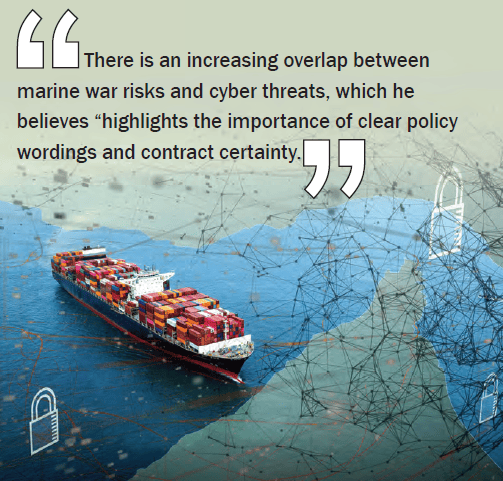
Mr Cao conceded that there is an increasing overlap between marine war risks and cyber threats, which he believes “highlights the importance of clear policy wordings and contract certainty”.
As such, to address these increasingly blurred lines between traditional marine war risks and state-backed cyber operations, MSIG Insurance (Singapore) places strong emphasis on ensuring policy coverage intent is clearly understood and is aligned with market standards, he continued.
“We conduct early discussions with clients and brokers on coverage expectations, as well,” he said.
If an incident occurs, “each case is assessed based on the available evidence, taking into account technical, legal and geopolitical factors”, according to Mr Cao.
“In more complex situations where attribution may be unclear, we may engage external specialists to support the assessment, with the aim of delivering consistent and transparent claims outcomes,” he said.
Additionally, Mr Cao noted that the insurer also engages insureds regularly on emerging cyber exposures and promotes greater awareness of cyber risk management and loss prevention measures as well.
These help shipowners make more informed risk management decisions, he stressed.
Evolving from risk transfer to risk partner
According to Mr Cao, his company is “evolving our role from being purely a risk transfer provider to a risk management partner”.
“We work closely with clients to identify supply chain vulnerabilities and emerging operational risks, while providing risk engineering support and tailored marine insurance solutions to strengthen resilience,” he said.
For instance, he pointed out that while the insurer does not provide delay insurance coverage, they instead “continue to support clients through risk advisory and underwriting expertise to help them navigate supply chain disruptions and route diversions in a complex trading environment”

