


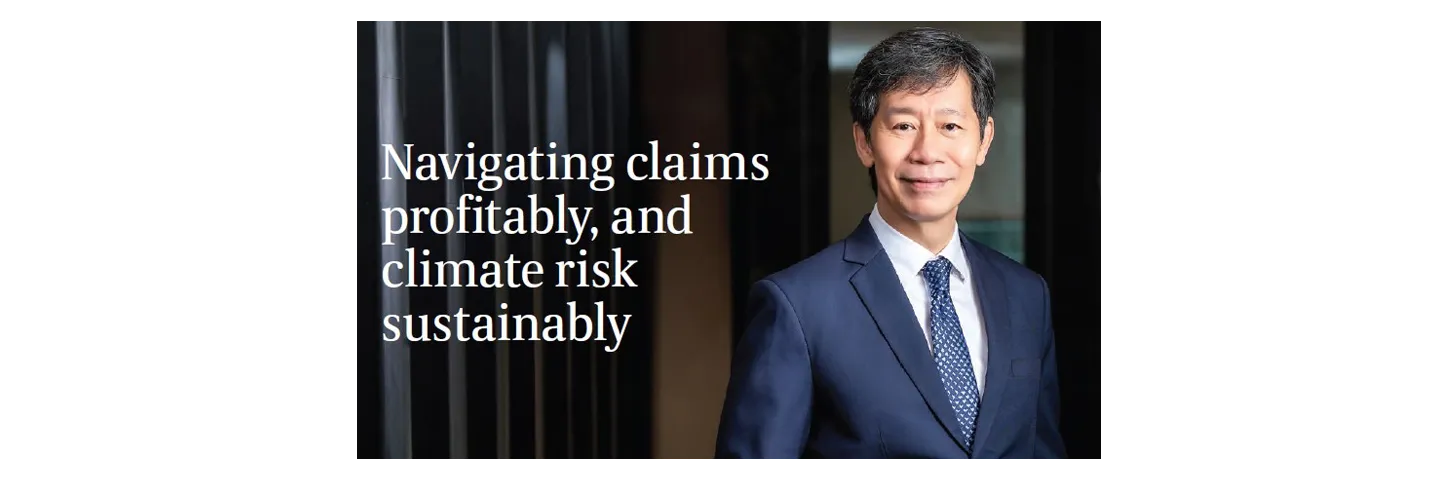
Navigating claims profitably, and climate risk sustainably
20 Nov 2026
The following article was published in Asia Insurance Review on 2 November 2026.
While claims outcomes are affected by inflation, higher material costs and supply chain pressures, insurers also have to face increasingly unpredictable climate patterns.
To address these issues, MSIG Singapore’s Mr Mack Eng suggests greater emphasis on risk engineering, loss prevention and business continuity planning to help reduce claim frequency and severity, as well as resilience and risk prevention.
By Sarah Si
Over the past year, Singapore’s non-life insurance market has remained resilient. In fact, according to the General Insurance Association of Singapore, the domestic general insurance sector crossed S$6bn ($4.73bn) in gross written premiums for the first time in 2025, due to 8.4% year-on-year growth.
And according to MSIG Singapore CEO Mack Eng, speaking with Asia Insurance Review, “This points to a market that continues to grow, although claims pressure is becoming more apparent, particularly in motor and property lines.”
Notable developments
Mr Eng touched on several notable developments in Singapore’s non-life insurance market over the past year, starting with “the impact of global trade uncertainty and tariff developments”.
“While the direct impact on Singapore has been relatively measured, rising costs of materials and labour have contributed to higher claims costs and longer repair and project timelines,” he said.
“Businesses are also placing greater emphasis on supply chain resilience and business interruption protection.”
Additionally, the risk landscape is evolving with rapid technological change, he continued, saying, “Cyber risk remains a key concern, with SMEs becoming more aware of their exposure to cyber threats and enquiring on cyber insurance protection.”
Lastly, he highlighted demand for lifestyle and personal protection products, including travel, health related coverage and pet insurance, has also remained strong.
He said, “Travel insurance continues to benefit from healthy outbound travel, while pet insurance is gaining traction alongside rising pet ownership and veterinary costs.”
Looking into claims
Maintaining profitability with rising costs
According to Mr Eng, inflation, higher material costs, supply chain pressures and rising repair costs are “affecting both claims outcomes and the adequacy of insurance protection”.
“A key priority is working closely with insureds to keep asset valuations, sums insured and policy limits aligned with current replacement and reinstatement costs, reducing the risk of underinsurance,” he said.
“We also regularly review policy terms, deductibles, pricing and portfolio performance to ensure they remain commensurate with the underlying risk environment.”
Additionally, MSIG Singapore “places greater emphasis on risk engineering, loss prevention and business continuity planning to help reduce claim frequency and severity”, he continued.
“Supported by disciplined underwriting and reinsurance strategies, this enables us to maintain a sustainable portfolio while continuing to provide reliable protection for our customers,” he said.
Balancing machine efficiency and human empathy
Mr Eng believes that technology and human empathy are not competing priorities. “Instead, they work hand in hand to help us deliver claims that are fair, timely and handled with care. Our approach is to use technology to simplify processes, reduce waiting times and improve transparency, while allowing our claims professionals to focus on delivering support where it matters most.”
Citing processes in his company as an illustration, he noted that while initiatives like straight-through processing and automated payments helped resolve routine claims more efficiently, the ‘human touch’ ensured customers facing more complex situations continued to receive personalised guidance and care.
“At the same time, we recognize that many claims arise from stressful life events such as accidents, medical emergencies, property damage or business disruption,” he said.
“In these moments, customers value reassurance and empathy. That is why our vision includes initiatives like support for complex or sensitive claims, proactive milestone updates and enhanced customer engagement throughout the claims journey.”
In conclusion, he stressed that while technology can improve speed, efficiency and transparency, complex claims decisions still require the judgement and empathy of experienced claims professionals.
Human oversight will also remain essential “to ensuring robust governance and fair, balanced outcomes”, he said.
Writing climate risk sustainably
In the face of increasingly unpredictable climate patterns, Mr Eng stated that MSIG Singapore is “strengthening its underwriting discipline by incorporating climate considerations into risk selection, risk assessment, accumulation management and reinsurance planning to ensure long-term portfolio resilience”, in order to write climate-related risks for P&C and marine sustainably.
As he put it, MSIG Singapore’s objective “is not to restrict capacity, but to ensure coverage remains sustainable, appropriately priced and aligned with the underlying risk profile”.
“We also place greater emphasis on risk prevention and resilience,” he said.
“Customers that invest in measures such as flood mitigation, fire protection, asset maintenance and business continuity planning are often better positioned to manage climate related exposures and achieve more sustainable insurance outcomes.”
At the same time, the insurer leverages opportunities to support the transition to a lower-carbon economy.
Citing MSIG Singapore’s specialist partnership with RiskPoint Group as an example, he noted that the insurer provides insurance solutions for renewable energy risks, including wind, solar and battery energy storage projects, supported by the appropriate underwriting expertise and risk controls.
“Over the next one to five years, our focus will be on deepening climate risk insights, strengthening collaboration with customers and risk partners, as well as promoting risk prevention and loss mitigation measures to build sustainable and resilient portfolios across both P&C and marine lines,” he said.
Navigating regulatory updates
“We view regulatory developments as an important part of maintaining trust and delivering fair outcomes for customers,” said Mr Eng.
“Our approach is to ensure that products, underwriting practices and policy wordings remain aligned with evolving requirements, while making coverage clearer and easier to understand.”
He also highlighted that the insurer places “strong emphasis on underwriting governance, supported by robust risk assessment, regular reviews, audits and cross-functional collaboration to ensure our solutions remain compliant and customer focussed”.
“As technology becomes more embedded in the insurance value chain, we are mindful of the responsible use of AI, with a focus on fairness, transparency and customer outcomes,” he said.
“For customers, this translates into clearer communication and insurance solutions that remain relevant and compliant in a changing regulatory environment.”
Looking ahead
When asked what trends he anticipates seeing over the coming year, Mr Eng noted his expectations that Singapore’s non-life insurance market remains resilient, “although insurers are likely to place greater emphasis on underwriting discipline and sustainable profitability amid rising claims costs, particularly in motor and property lines”.
“Technology will continue to reshape the industry, with generative AI and data analytics playing a larger role in underwriting, claims management, fraud detection and customer engagement,” he said.
“As adoption accelerates, strong governance and responsible implementation will become increasingly important.”
He also stressed that AI is “raising the sophistication of cyber threats, from highly targeted scams to more advanced attacks”.
“This will place greater emphasis on cyber resilience and create growing demand for insurers that can help clients manage emerging digital risks with confidence,” he said.
Additionally, Mr Eng expects digital and embedded insurance “to gain further momentum as insurers, InsurTechs and platform providers compete to deliver more seamless and accessible customer experiences”.
“Demand for lifestyle and specialty protection solutions is likely to grow, driven by greater awareness of emerging risks and evolving protection needs,” he said.
“Areas such as travel, pet, cyber and SME insurance are expected to see continued interest as customers seek more relevant and personalized protection.”

